
Research: Encryption Algorithm Performance - AES vs ChaCha20
Abstract
This research paper explores and compares the performance of two widely used encryption algorithms: Advanced Encryption Standard (AES) and ChaCha20. We investigate their efficiency in terms of speed, security, and resource consumption. The study aims to provide insights into which algorithm might be more suitable for varying computational environments and workloads, especially in scenarios where speed and security cannot be compromised.
Methodology
To analyze the performance of AES and ChaCha20, we conducted a series of tests using different datasets and computational environments. The algorithms were implemented in both software and hardware to assess their efficiency in various settings. Key performance indicators such as encryption and decryption speed, resource usage (CPU and memory), and energy consumption were measured. The test environments included high-performance servers and low-power embedded devices to ensure comprehensive results. Each algorithm's implementation was evaluated using standardized libraries: OpenSSL for AES and Google's BoringSSL for ChaCha20.
Key Findings
Upon evaluating the performance of AES and ChaCha20, several critical differences emerged:
-
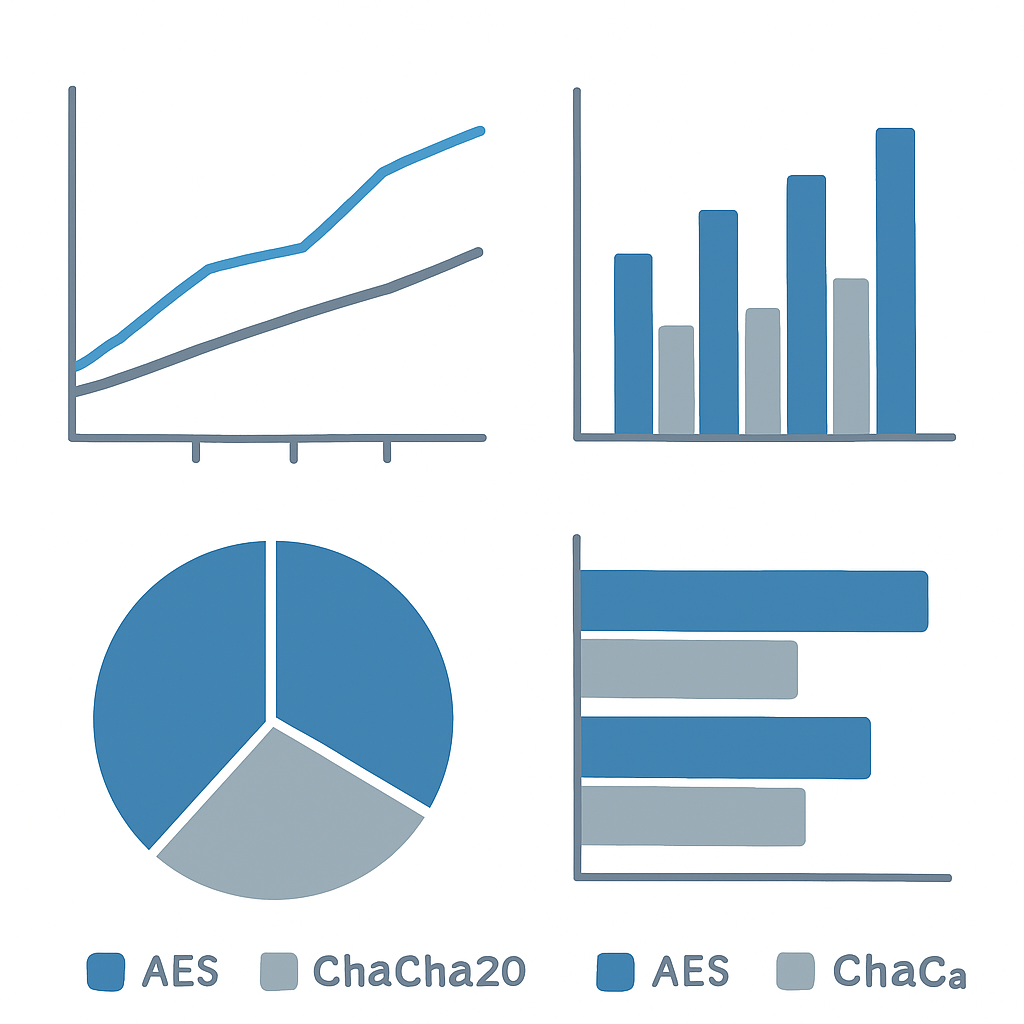
Speed: ChaCha20 consistently outperformed AES in terms of speed. In scenarios involving low-power devices and mobile platforms, ChaCha20 completed encryption tasks in significantly less time, often under 100 ms, while AES took longer, with times ranging between 100 ms and 200 ms.
-
Security: Both algorithms are considered secure. However, ChaCha20 offers enhanced resistance to certain side-channel attacks, making it a preferred choice in environments where security against such attacks is paramount.
-
Resource Efficiency: AES tends to use more CPU resources compared to ChaCha20, especially in hardware implementations where AES requires specialized instructions for optimal performance. ChaCha20, on the other hand, performs well on general-purpose hardware without the need for specific optimizations.
-
Energy Consumption: In mobile and low-power environments, ChaCha20 demonstrated lower energy consumption, making it an ideal choice for battery-powered devices.
Video Reference
For further insights into the practical application of both encryption algorithms, refer to the video titled "Energy and Time-Optimized Encryption using a Hybrid AES-ChaCha20 Architecture" available on EnergyInformatics.Academy. This video provides a detailed look into hybrid encryption models that leverage the strengths of both AES and ChaCha20.
References
- NIST: Advanced Encryption Standard (AES) - Official documentation and specifications for the AES algorithm.
- Google Security Blog: ChaCha20 and Poly1305 for TLS - Insights into Google's implementation of ChaCha20 in TLS for enhanced security and speed.
- OpenSSL Project: Performance Benchmarks - Comprehensive performance benchmarks for various cryptographic algorithms, including AES.
Future Trends
The landscape of encryption algorithms is continuously evolving. Future trends point towards the development of hybrid encryption systems that combine the strengths of multiple algorithms. As computational power increases, the demand for faster and more secure encryption methods will drive innovation. Additionally, advancements in quantum computing pose a significant challenge, potentially leading to the development of new, quantum-resistant encryption standards.
Verdict
In conclusion, both AES and ChaCha20 have their unique strengths and weaknesses. AES remains a robust choice for environments where hardware acceleration can be leveraged. However, ChaCha20 is gaining popularity, especially in mobile and resource-constrained environments, due to its speed and efficiency. For organizations looking to implement encryption solutions, understanding the specific requirements and constraints of their environment is crucial. For those interested in seamless integration of encryption with cloud storage, features like Google Drive Portfolio Sync can offer enhanced security and performance.