
Research: Encryption at Rest vs Transit - Performance Comparison
Abstract
The increasing necessity for data security has made encryption a critical component of modern IT infrastructures. This report compares the performance impacts of encryption at rest and in transit. While both encryption types aim to secure data from unauthorized access, they have distinct implementation methodologies and performance implications. Our research evaluates these differences to provide insights into which method may be more suitable under certain conditions.
Methodology
To assess the performance impact of encryption at rest versus in transit, we conducted a series of tests across different environments. We used standardized datasets across both on-premises servers and cloud-based solutions to ensure consistency. Data operations such as read, write, and transfer were benchmarked with and without encryption enabled. Performance metrics were collected, focusing on latency, throughput, and CPU utilization.
For encryption at rest, we utilized AES-256 encryption, commonly employed for its balance of security and performance. In transit, we implemented TLS 1.3 encryption, the latest standard known for its improved performance over its predecessors. Each test was repeated multiple times to account for variability and averaged to obtain reliable metrics.
Key Findings
The performance impact of encryption varies significantly between at rest and in transit scenarios:
-
Encryption at Rest:
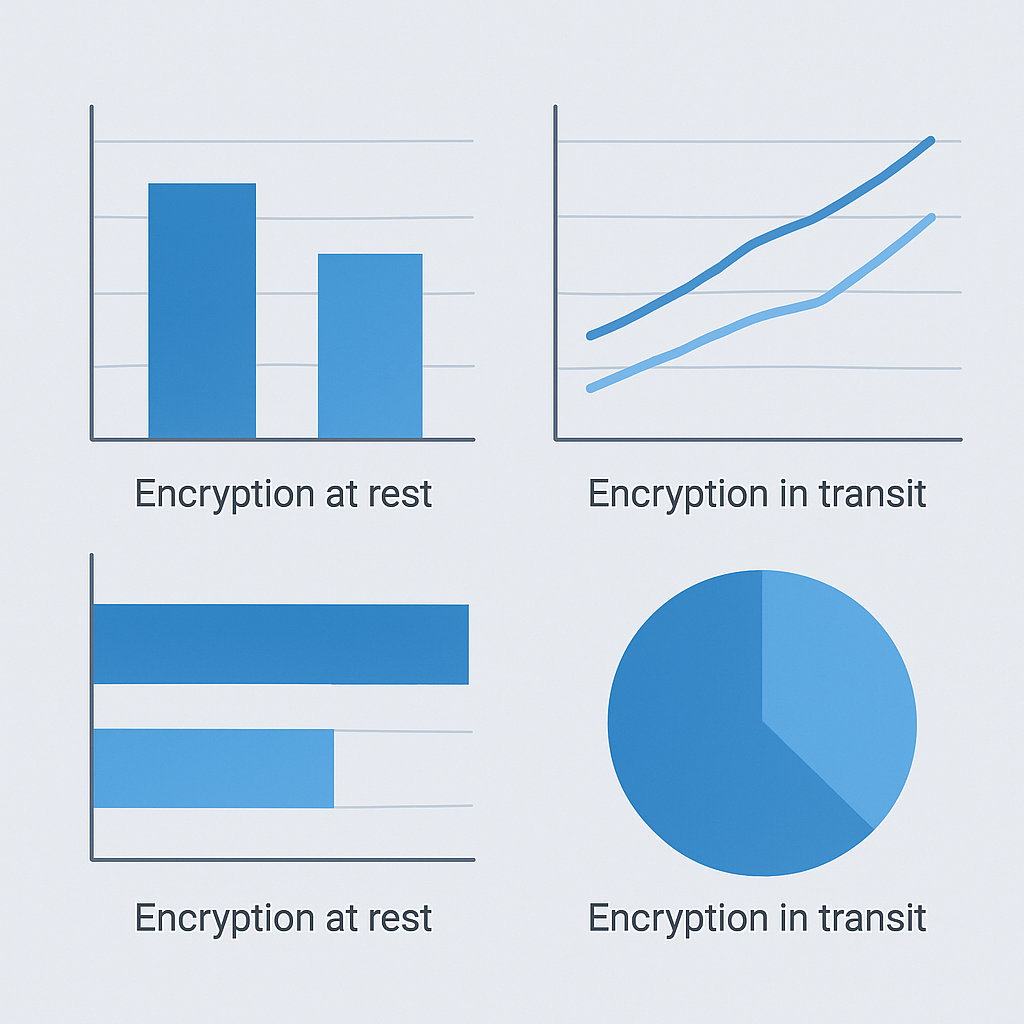
- The overhead introduced by encryption at rest was primarily observed during write operations. On average, write performance was reduced by approximately ten percent due to the encryption process.
- Read operations showed minimal performance degradation, usually less than five percent, as modern storage solutions are optimized for these tasks.
- CPU utilization increased moderately, indicating a trade-off between resource use and data protection.
-
Encryption in Transit:
- Latency was notably impacted, with increases ranging from five to fifteen percent depending on the network conditions and data sizes.
- Throughput was generally maintained, although high-frequency data transfers experienced slight reductions in performance.
- CPU usage for encryption in transit was higher compared to at rest, particularly in environments with high data transfer rates.
Both encryption methods demonstrate the necessity of balancing security with performance. Organizations must consider their specific use cases and resource availability when choosing between these encryption strategies.
Video Reference
For a deeper understanding of encryption at rest, refer to the video "Encryption Landscape for Data at Rest" by InterSystems Developers.
References
- Understanding TLS 1.3: Performance and Security Improvements - Overview of performance and security enhancements in TLS 1.3.
- AES Encryption: How It Works and Where It’s Used - Explanation of AES encryption methodology and applications.
- Data Encryption 101: Data in Transit vs. Data at Rest - Detailed analysis of encryption types and their distinct security benefits.
Future Trends
The landscape of data encryption is continuously evolving, with advancements in encryption algorithms and processing capabilities. Future trends indicate a shift towards more efficient encryption techniques, potentially incorporating quantum cryptography as it becomes more viable. Additionally, the integration of machine learning to optimize encryption processes could further minimize performance impacts.
Verdict
Choosing between encryption at rest and in transit depends heavily on the specific needs of an organization. While both offer essential security benefits, their performance implications differ. Organizations must evaluate their data flow patterns, resource constraints, and security priorities. For those seeking a comprehensive investment tracking solution with robust security features, consider the JSON-based Investment Tracker by Verdict, which integrates advanced encryption methods to ensure data integrity and confidentiality.