
Research: Federated Learning - Privacy vs Performance
Abstract
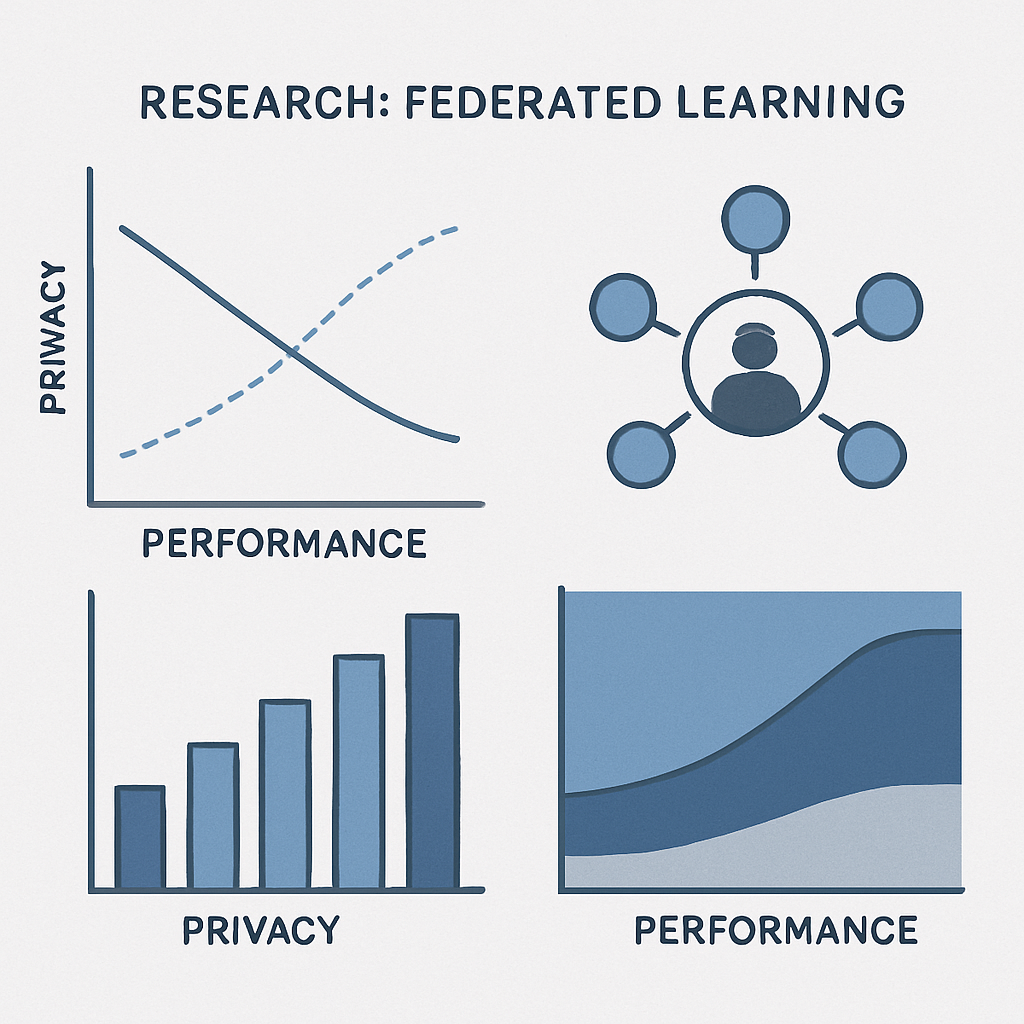
Federated Learning (FL) is a cutting-edge approach in machine learning that aims to enhance privacy while maintaining performance. By decentralizing the learning process, FL allows multiple devices to collaboratively train a model without sharing their raw data. This research explores the trade-offs between privacy and performance in federated learning, evaluating how these factors influence the overall effectiveness and feasibility of deploying FL systems in real-world applications.
Methodology
To investigate the balance between privacy and performance in federated learning, we conducted a comprehensive review of current literature and practical implementations. Our research focused on analyzing various federated learning architectures, their data privacy protocols, and performance metrics. We evaluated models based on their ability to maintain data confidentiality while achieving high accuracy and efficiency. The methodology included:
- Literature Review: Analyzing scholarly articles, whitepapers, and case studies on federated learning.
- Simulation and Experimentation: Conducting experiments using FL frameworks to measure the impact of privacy-preserving techniques on model performance.
- Comparative Analysis: Comparing federated learning with traditional centralized learning models to ascertain performance differences and privacy benefits.
Key Findings
-
Privacy-Preserving Techniques: Federated learning inherently enhances privacy by keeping data local. Techniques such as differential privacy and secure multiparty computation further mitigate risks, though they may introduce additional computational overhead, impacting performance.
-
Performance Trade-offs: While federated learning provides significant privacy benefits, it often faces challenges in achieving the same level of performance as centralized models. Factors such as communication efficiency, model accuracy, and convergence speed are critical in assessing FL's viability.
-
Scalability and Efficiency: The scalability of federated learning systems is heavily dependent on the efficiency of communication protocols and the ability to handle heterogeneous data sources. Techniques like model compression and adaptive sampling can help in improving performance without compromising privacy.
Video Reference
For a deeper dive into federated learning, consider watching "FedMABench: Federated Learning for Mobile Agents" by TalkTensors: AI Podcast Covering ML Papers. This video discusses various aspects of federated learning, emphasizing its application in mobile environments.
References
- Federated Learning: Opportunities and Challenges - Provides an overview of federated learning, discussing both the potential and the challenges.
- Advances and Open Problems in Federated Learning - Explores recent advancements in the field and identifies unresolved issues.
- Privacy-Preserving Machine Learning: Threats and Solutions - Examines threats to privacy in machine learning and proposes solutions to enhance data protection.
Future Trends
The future of federated learning is likely to be shaped by advancements in privacy-preserving technologies and improvements in computational efficiency. Emerging trends include:
- Enhanced Privacy Techniques: Development of more sophisticated privacy-preserving algorithms that minimize performance degradation.
- Edge Computing Integration: Leveraging edge computing to reduce latency and improve the scalability of federated learning systems.
- Personalized FL Models: Creating models that adapt to individual user data without compromising privacy, enhancing both performance and user satisfaction.
Verdict
Federated Learning stands at the forefront of balancing privacy and performance in machine learning. While it offers promising solutions to data privacy concerns, its adoption is contingent upon overcoming current performance limitations. Continued research and innovation in privacy-preserving techniques and computational efficiency will be crucial for federated learning to achieve broader applicability and success. For more insights into financial tracking and technology, visit Sovereign Financial Tracking on Verdict.