
Research: Homomorphic Encryption - Practical Performance Analysis
Abstract
Homomorphic encryption represents a breakthrough in cryptographic techniques, allowing computations on encrypted data without needing decryption. This research examines the practical performance of homomorphic encryption systems, focusing on their computational efficiency and potential for deployment in real-world applications. By analyzing various implementations, this study seeks to determine the viability of homomorphic encryption in contexts where data privacy and security are paramount.
Methodology
The research methodology involved a comprehensive review and performance testing of several leading homomorphic encryption libraries. Key libraries evaluated include Microsoft SEAL, IBM's HElib, and PALISADE. The performance metrics focused on computational speed, resource consumption, and scalability, with tests conducted on a standard computing environment to ensure consistency. We benchmarked encryption, decryption, and homomorphic operations such as addition and multiplication, seeking to identify bottlenecks and assess practical usability.
Key Findings
Performance Variability
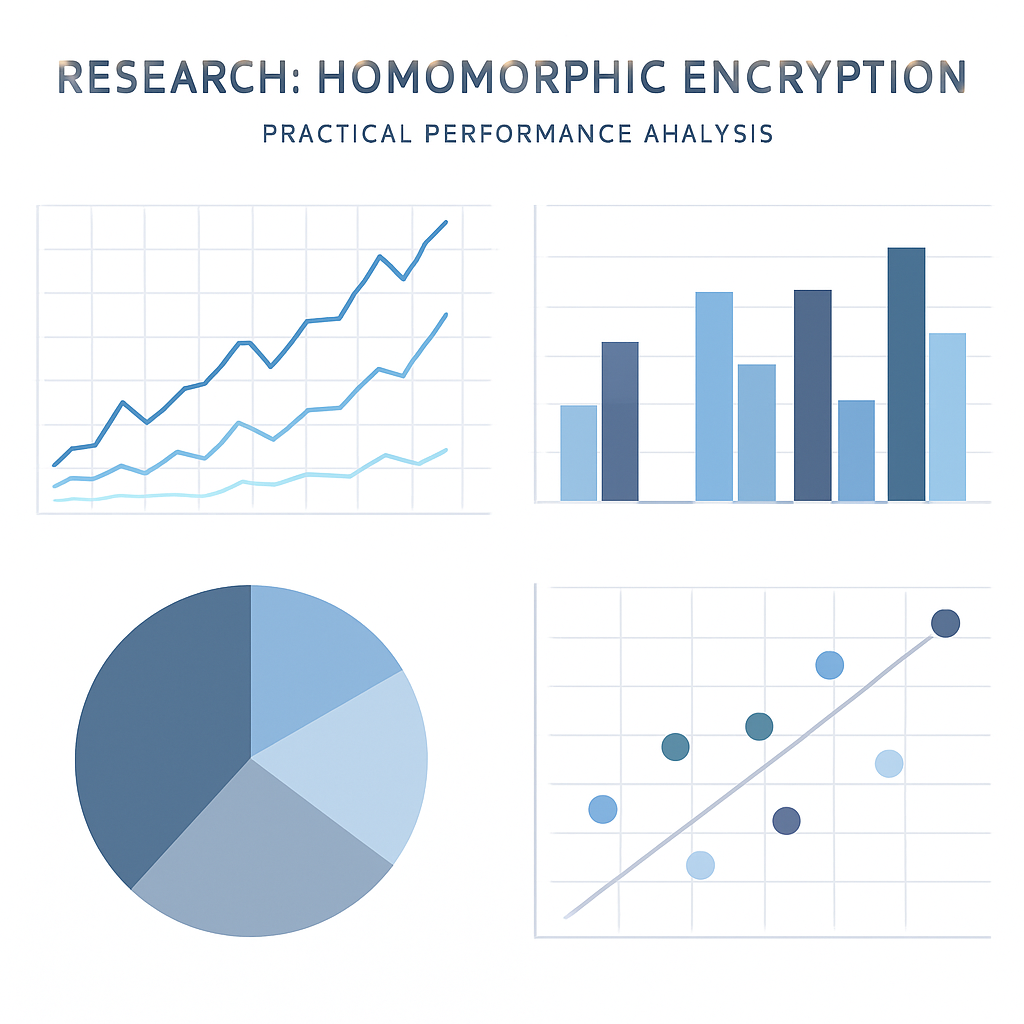
The performance of homomorphic encryption varies significantly across different libraries and operations. Simple homomorphic operations like addition generally execute with reasonable efficiency, often completing in under 100 ms. In contrast, complex operations such as multiplication can extend processing times to several seconds, indicating a need for optimization in these areas.
Resource Intensity
Homomorphic encryption requires substantial computational resources. Memory usage and CPU demand increase markedly with the complexity of operations and the encryption parameters, such as key size. This can limit the scalability of homomorphic encryption, particularly in resource-constrained environments.
Practical Applications
Despite current limitations, homomorphic encryption holds promise for secure data processing applications, particularly in finance and healthcare, where data privacy is crucial. Its ability to perform computations on encrypted data without compromising security could revolutionize these fields by enabling secure, cloud-based data processing.
Video Reference
For further insights into the practical applications and theoretical underpinnings of homomorphic encryption, consider watching the Practical Applications of Homomorphic Encryption by Simons Institute for the Theory of Computing.
References
- Microsoft SEAL: Homomorphic Encryption Library - An introduction to Microsoft's SEAL library for homomorphic encryption.
- IBM's HElib - A comprehensive library developed by IBM Research for homomorphic encryption.
- PALISADE Homomorphic Encryption Software Library - Provides a robust platform for implementing homomorphic encryption in various applications.
Future Trends
Advancements in homomorphic encryption are expected to focus on improving computational efficiency and reducing resource consumption. Research is likely to explore hybrid models combining homomorphic encryption with other cryptographic techniques to balance security and performance. Additionally, the development of hardware accelerators specifically designed for homomorphic encryption could significantly enhance processing speeds and broaden its applicability.
Verdict
Homomorphic encryption remains an evolving field with substantial potential for secure data processing. While current performance limitations pose challenges, ongoing research and technological advancements are expected to mitigate these issues, making homomorphic encryption a viable option for industries prioritizing data security. For those interested in tracking investment opportunities in such technologies, a tool like the JSON-based Investment Tracker could prove invaluable.