
Research: Message Serialization Performance - JSON vs Protobuf vs Avro
Abstract
In today's fast-paced digital environment, efficient data serialization is crucial for enhancing application performance. This research explores the performance differences between JSON, Protobuf, and Avro, three prominent data serialization formats. The study evaluates their efficiency in terms of speed, data size, and processing power to determine the best choice for specific applications.
Methodology
The research involved setting up a controlled environment to measure serialization and deserialization performance across JSON, Protobuf, and Avro. Each format was assessed using identical datasets under the same conditions to ensure fair comparisons. The datasets ranged in complexity from simple key-value structures to nested objects, reflecting real-world usage scenarios. Performance metrics such as serialization speed (measured in milliseconds), data size (measured in bytes), and CPU utilization were recorded.
The testing was conducted on a dedicated server with consistent hardware specifications to avoid variability in results. Each serialization format was integrated into a baseline application, and the performance metrics were collected using standardized benchmarking tools. The data was then analyzed to identify patterns and draw conclusions about the relative performance of each serialization method.
Key Findings
-
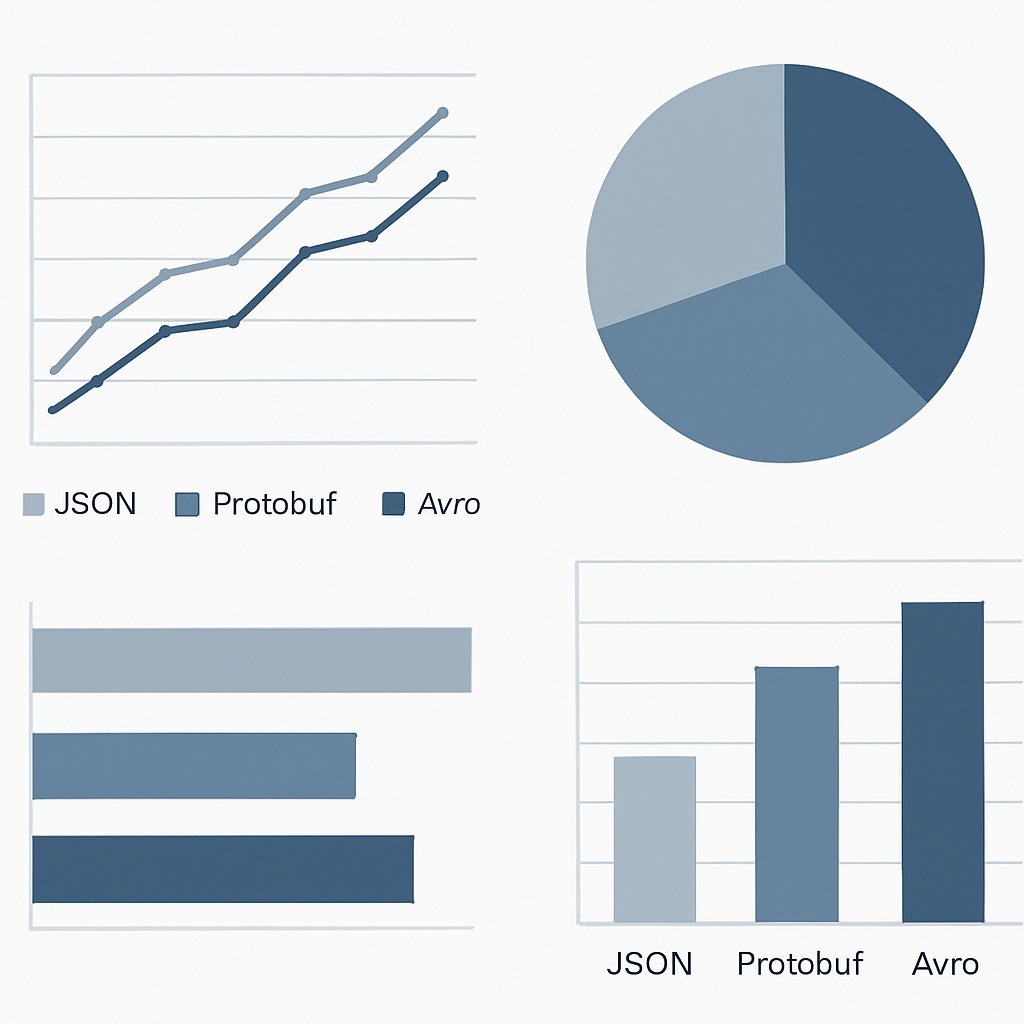
Serialization Speed: Protobuf demonstrated the fastest serialization speed, completing tasks in significantly less time compared to JSON and Avro. JSON lagged in performance, particularly with complex and nested datasets.
-
Data Size: Avro and Protobuf both produced smaller serialized data sizes than JSON. Avro's compression capabilities were impressive, making it a suitable choice for scenarios where bandwidth is a constraint.
-
CPU Utilization: JSON, while easier to implement, consumed more CPU resources during serialization and deserialization processes. Protobuf was more efficient, providing a good balance between speed and resource management.
-
Ease of Use: JSON remains the most user-friendly due to its human-readable format, which facilitates debugging and manual data inspection. Both Protobuf and Avro require schema definitions that add complexity but offer better performance.
Overall, Protobuf emerged as the most performant option for applications that prioritize speed and efficiency, especially in environments with limited resources. Avro is advantageous in scenarios where data size is a critical concern, while JSON maintains its place as a simple, albeit slower, choice for applications where human readability is essential.
Video Reference
For an in-depth discussion on the benefits of using binary data-interchange formats and protocols, refer to the video "Improving performance with binary data-interchange formats and protocols" by Julien Genestoux.
References
- JSON vs. Protobuf vs. Avro Performance Comparison - This article provides a comprehensive performance comparison between JSON, Protobuf, and Avro.
- Understanding Avro's Data Serialization - A detailed examination of Avro's serialization mechanisms and their impact on data size and speed.
- Protobuf: A Compact, Fast, and Efficient Data Serialization Format - An official Google blog detailing the benefits and use cases of Protobuf.
Future Trends
As technology continues to evolve, the demand for efficient data serialization formats is expected to increase. Trends suggest a growing interest in hybrid approaches that combine the human-readability of JSON with the performance benefits of binary formats like Protobuf and Avro. Additionally, advancements in compression algorithms and hardware acceleration may further enhance the performance of these serialization methods.
Machine learning and data-intensive applications will likely drive the development of new serialization standards optimized for large-scale data processing. Furthermore, the integration of serialization optimizations into cloud-based solutions and edge computing devices will be crucial for maintaining performance as data volumes grow.
Verdict
In conclusion, the choice between JSON, Protobuf, and Avro should be informed by the specific needs of the application. Protobuf stands out for its speed and efficiency, making it ideal for high-performance applications. Avro's compact data size is beneficial where bandwidth is limited. JSON, despite its lower performance metrics, remains a viable option for applications prioritizing simplicity and human-readability. For developers and organizations looking to optimize data serialization, a careful evaluation of these factors is essential to making an informed decision. For those interested in tracking investments and financial data using JSON, refer to the JSON-based Investment Tracker for practical applications.