
Research: WebAssembly Performance - JavaScript vs WASM
Abstract
WebAssembly (WASM) is revolutionizing the way developers think about performance on the web. While JavaScript has been the cornerstone of web development for decades, the introduction of WebAssembly offers a new paradigm that promises better performance and efficiency. This research explores the performance differences between JavaScript and WebAssembly, focusing on execution speed, computational efficiency, and real-world applications. By comparing both technologies, we aim to provide insights into when and why developers might choose one over the other.
Methodology
Our analysis consisted of benchmarking various algorithms and real-world applications written in both JavaScript and WebAssembly. The benchmarks included:
- Compute-intensive tasks: Tasks like matrix multiplications, image processing, and complex mathematical computations were analyzed to measure raw computational power.
- Execution speed: We measured the time taken from start to finish for both languages to complete tasks, with particular attention to cold start performance and warm execution cycles.
- Resource utilization: Memory and CPU usage were recorded to evaluate efficiency.
- Real-world applications: We analyzed scenarios such as gaming engines and data visualization libraries to assess practical performance differences.
Each test was conducted multiple times across different browsers and environments to ensure a comprehensive understanding of performance characteristics.
Key Findings
-
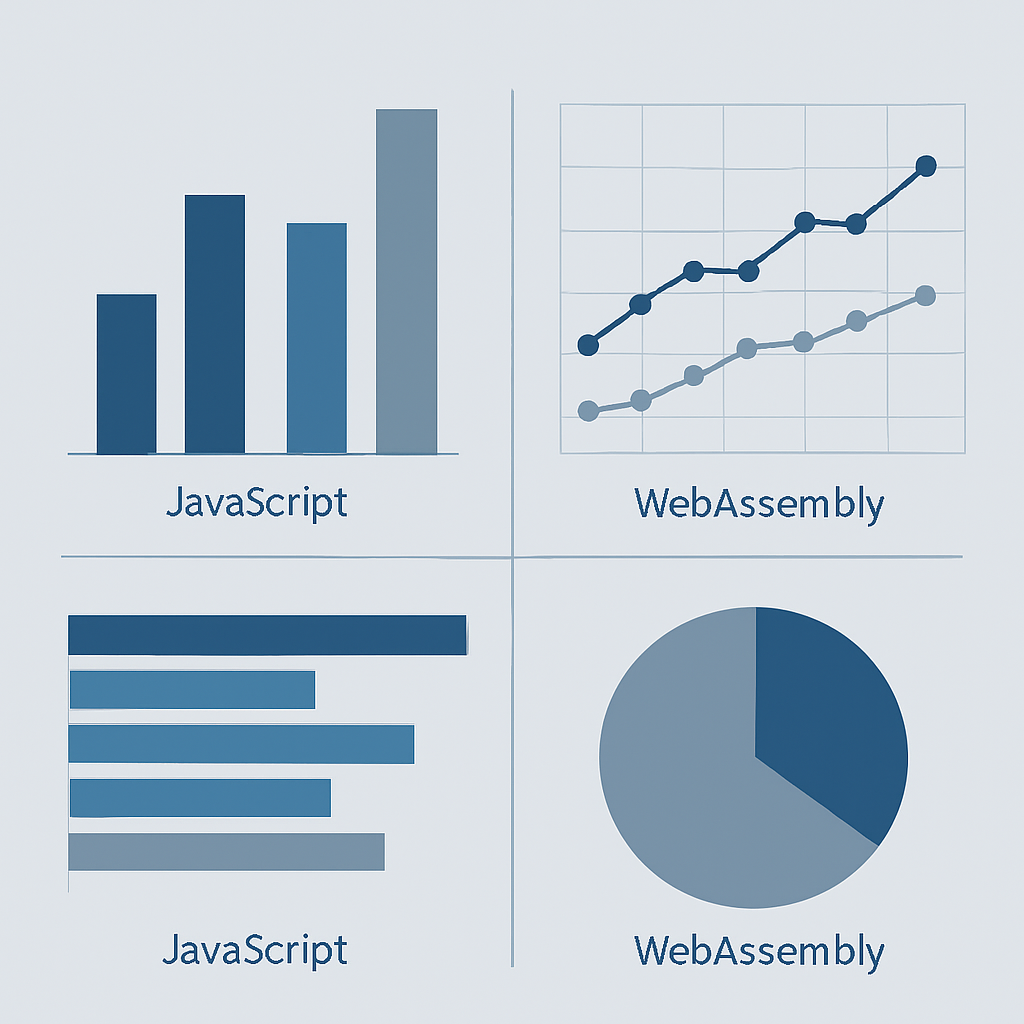
Execution Speed: WebAssembly consistently outperformed JavaScript in compute-intensive tasks, with execution times often being several times faster. This is largely due to WebAssembly's closer-to-native execution model, which allows for more efficient use of system resources.
-
Efficiency in Resource Utilization: WebAssembly demonstrated lower CPU and memory usage compared to JavaScript. This efficiency makes WASM particularly attractive for applications where performance and resource management are critical, such as mobile applications and embedded systems.
-
Real-World Application Performance: In gaming engines and other high-performance scenarios, WebAssembly offered a noticeable improvement in frame rates and responsiveness. However, for applications that heavily depend on the Document Object Model (DOM) or require frequent interaction with JavaScript, the performance gains were less pronounced.
-
Interoperability and Ecosystem: JavaScript still holds an advantage in terms of ecosystem maturity and ease of integration with existing web technologies. WebAssembly, while powerful, requires more effort in terms of tooling and debugging, though this gap is narrowing.
-
Cold Start vs. Warm Execution: While warm execution cycles showed significant performance improvements for WebAssembly, the initial load times (cold start) were sometimes slower due to the need to fetch and compile the WASM binary.
Video Reference
For a practical exploration, watch the video "WebAssembly is not as hard as it seems" by CodeTV, which provides an excellent introduction to WASM's capabilities and ease of use.
References
- MDN Web Docs - WebAssembly - A comprehensive resource for understanding WebAssembly and its integration into web projects.
- Google Developers - WebAssembly - Insights into the performance characteristics and use cases of WebAssembly by Google experts.
- V8 JavaScript Engine - Performance - Detailed documentation on the performance optimizations in the V8 JavaScript engine.
Future Trends
The future of WebAssembly looks promising, with ongoing developments aimed at improving its integration and performance on the web. Trends indicate a growing adoption in areas such as:
- WebAssembly System Interface (WASI): Expanding WASM's capabilities beyond the browser to server-side and standalone applications.
- Language Support: Increasing support for various programming languages, allowing developers to compile code from languages like Rust, C++, and Go to WASM.
- Tooling and Debugging Improvements: Enhanced developer tools and debugging capabilities to simplify the development process and accelerate adoption.
- Cloud Computing: As cloud services continue to evolve, WebAssembly's potential for efficient, serverless computing environments is gaining traction.
Verdict
WebAssembly offers significant performance benefits for compute-intensive and resource-constrained applications, making it a strong contender for future web development alongside JavaScript. However, the decision to use WebAssembly should be guided by specific use case requirements and the current maturity of the tooling ecosystem. For developers seeking to maximize performance and efficiency, exploring WebAssembly is a worthwhile endeavor. For more insights on managing and tracking investments in technologies like WebAssembly, consider using a JSON-based Investment Tracker.