
The End of Data Export — Why the Cloud is a Compliance Trap
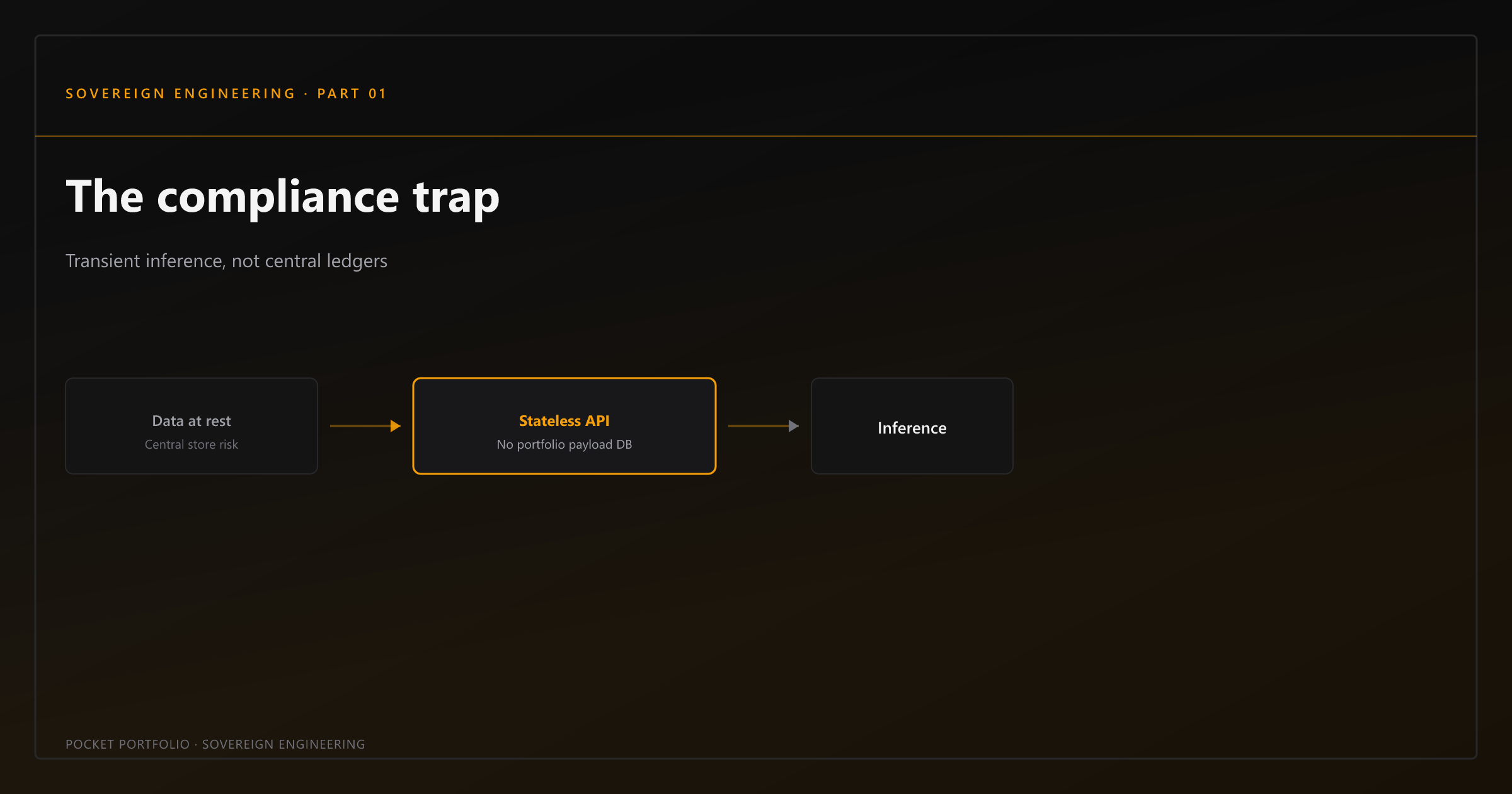
Sovereign Engineering · Part 1
Privacy is infrastructure. The high-risk pattern is not “using AI” — it is centralizing full financial ledgers in a vendor database or open-ended prompt logs.
Sovereignty is our architecture philosophy: user-anchored portfolio truth, cloud for compute not for hoarding the narrative, and a stateless Ask AI boundary — this post is the compliance-shaped case for that bet.
Typical stack vs Sovereign Ask AI
Typical stack: ingest everything into PostgreSQL, expose a central API, then “add AI” by sending too much row data to a model or vector store. Blast radius includes breach, subpoena, and data-minimization scrutiny.
Sovereign Ask AI: models still run in the cloud (Gemini/OpenAI), but the default portfolio signal is a client-built bounded string — totals + top-N holdings — and POST /api/ai/chat is stateless for that payload: no portfolio row store on our side for inference. Residency (region) is a different axis; it does not replace this philosophy.
Stateless boundary (app/api/ai/chat/route.ts)
/**
 * Stateless: request payload (message, context, attachedContent) is used only
 * to build the LLM prompt and stream the response. No database write or cache
 * of the payload; only analytics/quota metadata are persisted.
 */
Operational writes (telemetry, not your ledger text) — toolUsage metadata such as uid, tier, hadAttachment, provider:
await db.collection('toolUsage').add({
  toolType: 'pocket_analyst',
  action: payload.action,
  metadata: {
    uid: payload.uid,
    tier: payload.tier ?? null,
    isPaid: payload.isPaid ?? false,
    hadAttachment: payload.hadAttachment ?? false,
    provider: payload.provider ?? null,
    status: payload.status ?? null,
    errorCode: payload.errorCode ?? null,
  },
  timestamp: Timestamp.now(),
});
Plain limits: attachment text is in the prompt for that request. Narrow retention supports the privacy story; sector-specific compliance still needs its own process.
Read the Sovereign Intelligence book or try Pocket Portfolio.