
Understanding Event Sourcing
Problem
In traditional CRUD-based systems, maintaining a consistent state across distributed systems can be challenging. Such systems often face issues with data integrity and auditability, as changes overwrite previous states. This makes it difficult to reconstruct the state of the system at any point in time.
Solution
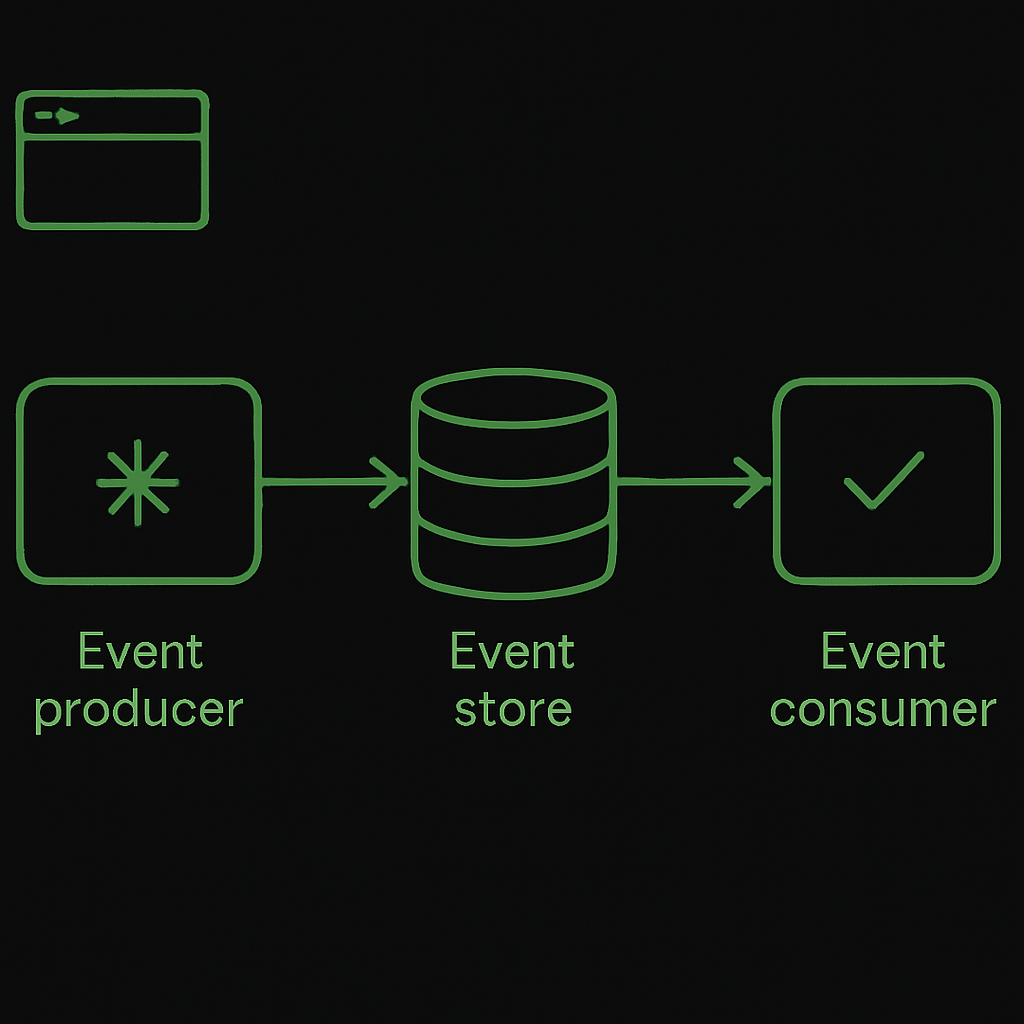
Event sourcing offers a solution by storing a sequence of events that represent all changes to the state of the system. Instead of persisting the current state, you persist events that lead to that state. This approach enhances traceability, auditability, and consistency across distributed applications.
Key Concepts
-
Event: A record of a change that occurred. Events are immutable and append-only, meaning they cannot be altered once stored.
-
Event Store: A database or storage system that saves events. It acts as the primary source of truth in an event-sourced system.
-
Aggregate: An entity or group of entities treated as a single unit for the purpose of data changes. Aggregates apply events to transition between states.
-
Command: A request to perform an action that results in one or more events. Commands are not part of the event store but trigger the creation of events.
-
Projection: A read model derived from events, optimized for querying. It represents the current state by replaying events and can be tailored for specific query patterns.
Implementation
Here's a simple implementation example in Node.js using a hypothetical event sourcing library:
const { EventStore, AggregateRoot, CommandHandler } = require('event-sourcing-lib');

class Account extends AggregateRoot {
  constructor(id) {
    super();
    this.id = id;
    this.balance = 0;
  }

  apply(event) {
    switch (event.type) {
      case 'AccountCreated':
        this.balance = 0;
        break;
      case 'MoneyDeposited':
        this.balance += event.amount;
        break;
      case 'MoneyWithdrawn':
        this.balance -= event.amount;
        break;
    }
  }

  createAccount() {
    this.applyEvent({ type: 'AccountCreated', id: this.id });
  }

  depositMoney(amount) {
    this.applyEvent({ type: 'MoneyDeposited', amount });
  }

  withdrawMoney(amount) {
    if (this.balance >= amount) {
      this.applyEvent({ type: 'MoneyWithdrawn', amount });
    } else {
      throw new Error('Insufficient funds');
    }
  }
}

const commandHandler = new CommandHandler();
const eventStore = new EventStore();

commandHandler.register(Account, eventStore);

const account = new Account('123456');
account.createAccount();
account.depositMoney(100);
account.withdrawMoney(50);

eventStore.save(account);
Benefits
- Auditability: Every change is logged as an event, providing a clear audit trail.
- Scalability: Event stores can be optimized for high throughput.
- Flexibility: New projections can be created without altering existing data.
- Resilience: Systems can recover from failures by replaying events.
By understanding and implementing event sourcing, you can build systems that are more reliable, maintainable, and aligned with modern distributed architectures.