
Bypassing Central Supplier List Friction via Client-Edge Architecture
B2B Scenario Brief · Part 2 · Wealth practice directors & central compliance
Regulated wealth networks often block new cloud tools at the Approved Supplier List (ASL) layer—not because the use case is wrong, but because the data-flow story is wrong. If a vendor requires uploading full broker exports to a central parse API, compliance teams must treat that vendor as a processor of itemized client ledgers. Review cycles stall.
Client-edge architecture changes the procurement conversation: the institution evaluates a limited-scope processor pattern, not another data lake with a chat UI.
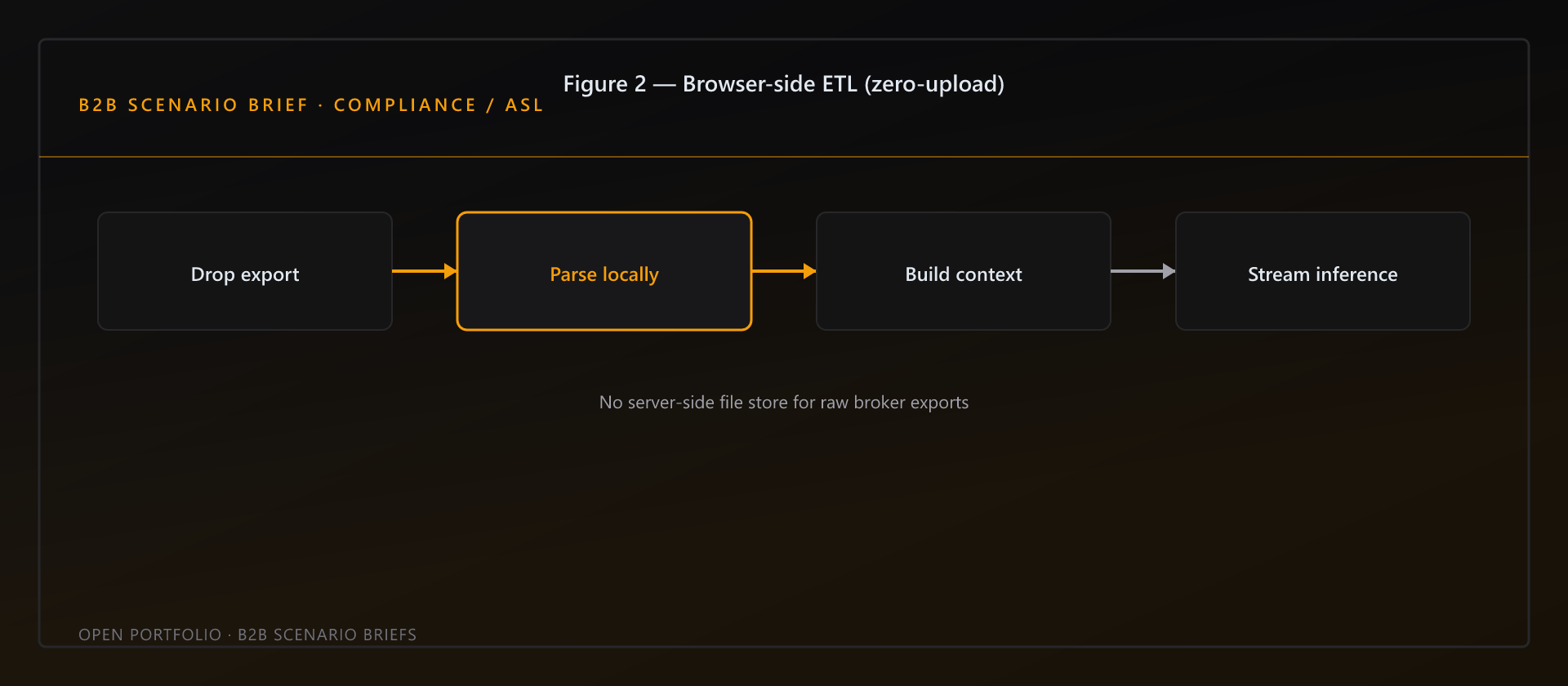
Figure 2 — Browser-side ETL (zero-upload). Parse and normalize inside client runtime before any cloud inference. No raw CSV upload API.
The Centralized Procurement Bottleneck
Typical blocked pattern:
- Adviser exports a client portfolio CSV.
- Upload goes to a vendor cloud for normalization and storage.
- AI features read from that warehouse.
Central compliance sees: new subprocessor, indefinite retention, unclear prompt logging, and expansion of breach blast radius. ASL committees default to no because the architecture forces a binary choice—either block the tool or accept full custody transfer.
The structural fix is not a better DPA template alone. It is not sending the full file to the vendor for parse.
Zero-Upload Architecture: What the Server Perimeter Never Receives
@pocket-portfolio/importer (MIT, 19+ broker adapters) runs normalization in the client runtime. Trades are mapped to a shared NormalizedTrade schema locally. The server-side parse API for raw CSV does not exist in this design.
What compliance can document:
- Controller: the wealth firm (client data stays in workflows they approve).
- Processor scope: bounded inference and optional sync layers—scoped in the pilot, not assumed infinite.
- Egress default: a semantic summary for Ask AI, not row replay.
This is the difference between "another SaaS with our CSVs" and "a boundary layer we can inspect."
Local Browser-Memory Execution for Regulated Wealth Networks
Execution model for a practice or sandbox pilot:
| Step | Location | Data that leaves the device |
|---|---|---|
| Load export | Client browser memory | None (local file read) |
| Normalize trades | Client (@pocket-portfolio/importer) | None |
| Build context | Client (buildPortfolioContext) | None until POST |
| Stream inference | Stateless /api/ai/chat | Bounded summary + user message only |
Network monitoring in a pilot should confirm: the wide payload (full export) never leaves the approved perimeter unless the institution explicitly chooses a sync path they control.
Plain limits: Optional cloud sync (Firebase on the consumer harness) is a separate axis from inference. Enterprise scoping should treat sync, inference, and model providers as independent subprocessors in the ASL narrative.
Frequently asked questions
Does client-edge parsing mean no vendor review at all?
No. Model providers and hosting still require review. The win is narrower scope—you are not approving indefinite warehouse custody of every client row for the sake of a chat feature.
Can compliance approve a pilot without a full ASL cycle?
Many firms run sandbox exceptions when data categories are bounded and retention is forgetful on the inference path. Frame the pilot as edge-only parse with network captures—not production rollout.
What if our network blocks all external LLM calls?
BYOC and VPC-side deployment are the enterprise extension of the same contract. See the 90-day sandbox reference pattern.
Where is the importer source?
packages/importer on npm as @pocket-portfolio/importer — inspectable MIT boundary.
Next steps: Architecture · Tier-1 design partner · Data Chasm brief · Enterprise design partnership